Be yourself; Everyone else is already taken.
— Oscar Wilde.
This is the first post on my new blog. I’m just getting this new blog going, so stay tuned for more. Subscribe below to get notified when I post new updates.
Be yourself; Everyone else is already taken.
— Oscar Wilde.
This is the first post on my new blog. I’m just getting this new blog going, so stay tuned for more. Subscribe below to get notified when I post new updates.

A Critical Section can be defined as a code segment which accesses shared variables, that needs to be excuted as an atomic action.
In simple words, at a given point of time, in a group of cooperating processes, in its critical section not more than one process can be executed. If, at the same time any other process want to access its critical section, then it must wait for the first process to finish its critical section.
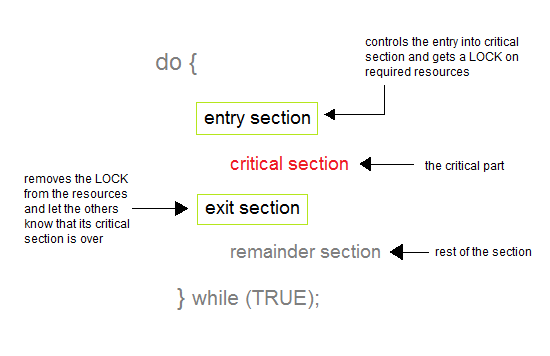
To avoid critical section problem it should satisfy the following conditions-
1. Mutual Exclusion
It means that if one process is accessing the shared variables or is executing inside its critical section then no other process can enter the critical section.

2. Progress
In the critical section if there are no processes, and if any one or more processes wants to enter their critical section, then any of the processes can be allowed to enter into its critical section.
3. Bounded Waiting
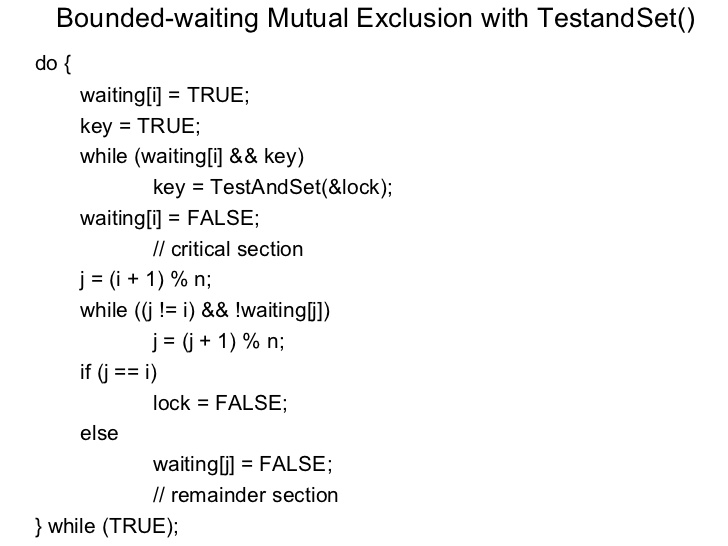
There is a specified limit for how many program can execute their critical section, so, when a process ask to enter its critical section and if the limit is reached then the system must grant permission for entering into its critical section.
This is an example post, originally published as part of Blogging University. Enroll in one of our ten programs, and start your blog right.
You’re going to publish a post today. Don’t worry about how your blog looks. Don’t worry if you haven’t given it a name yet, or you’re feeling overwhelmed. Just click the “New Post” button, and tell us why you’re here.
Why do this?
The post can be short or long, a personal intro to your life or a bloggy mission statement, a manifesto for the future or a simple outline of your the types of things you hope to publish.
To help you get started, here are a few questions:
You’re not locked into any of this; one of the wonderful things about blogs is how they constantly evolve as we learn, grow, and interact with one another — but it’s good to know where and why you started, and articulating your goals may just give you a few other post ideas.
Can’t think how to get started? Just write the first thing that pops into your head. Anne Lamott, author of a book on writing we love, says that you need to give yourself permission to write a “crappy first draft”. Anne makes a great point — just start writing, and worry about editing it later.
When you’re ready to publish, give your post three to five tags that describe your blog’s focus — writing, photography, fiction, parenting, food, cars, movies, sports, whatever. These tags will help others who care about your topics find you in the Reader. Make sure one of the tags is “zerotohero,” so other new bloggers can find you, too.

 Priyansh's Blog